Bianca Lang · 11 September 2026
Poland's Vocational Expansion Targets Rural Skill Shortages Through Targeted Grant Programs
Poland has rolled out an ambitious set of grant programs designed to expand vocational training opportunities in rural communities, where skill gaps in agriculture, manufacturing, and renewable energy sectors continue to widen. The initiative channels funding directly to local training providers, employers, and municipalities, aiming to equip workers with practical competencies that match regional labor market demands. Data from the Polish Ministry of Education and Science shows rural unemployment rates hovering around 6.8 percent in 2025, compared with 4.2 percent in urban centers, highlighting the uneven distribution of skilled labor across the country.
Grant Structure and Funding Allocation
Officials have structured the grants around three main pillars: equipment modernization for vocational schools, employer-led apprenticeship schemes, and short-cycle certification courses in high-demand trades. Each pillar receives dedicated budget lines drawn from both national resources and European Union cohesion funds, with total allocations exceeding 1.2 billion złoty for the 2025-2027 period. Applications opened in early 2025, and authorities expect to approve the first wave of projects by September 2026, allowing participating institutions to begin enrollment for the autumn semester.
Regional development agencies coordinate the application process, requiring proposals to demonstrate measurable outcomes such as the number of participants who secure employment within six months of completion. Priority goes to counties where the share of residents holding vocational qualifications falls below the national average of 32 percent. This geographic targeting reflects statistical analysis from the Central Statistical Office of Poland, which identified 187 rural gminas facing acute shortages in mechatronics, precision agriculture, and green technology maintenance.
Addressing Specific Rural Skill Gaps
Many rural economies in Poland still rely heavily on traditional farming and small-scale manufacturing, yet these sectors now require workers who understand digital monitoring systems, automated machinery, and sustainable resource management. The grant programs therefore emphasize training modules that combine classroom instruction with hands-on practice on updated equipment. One pilot project in the Podlaskie Voivodeship, for instance, introduced drone operation and soil-sensor calibration courses that enrolled 240 participants in its first year.
Employers in the renewable energy field have also joined the effort. Wind turbine maintenance companies operating in northern Poland report difficulty finding technicians with both mechanical and electrical certifications. Grant-supported programs now partner with these firms to deliver specialized modules that include safety protocols for heights above 80 meters and troubleshooting of variable-speed drives. According to figures released by the European Centre for the Development of Vocational Training, similar targeted interventions in other EU member states have raised completion rates by 18 percent when industry partners participate directly in curriculum design.
Implementation Timeline and Monitoring
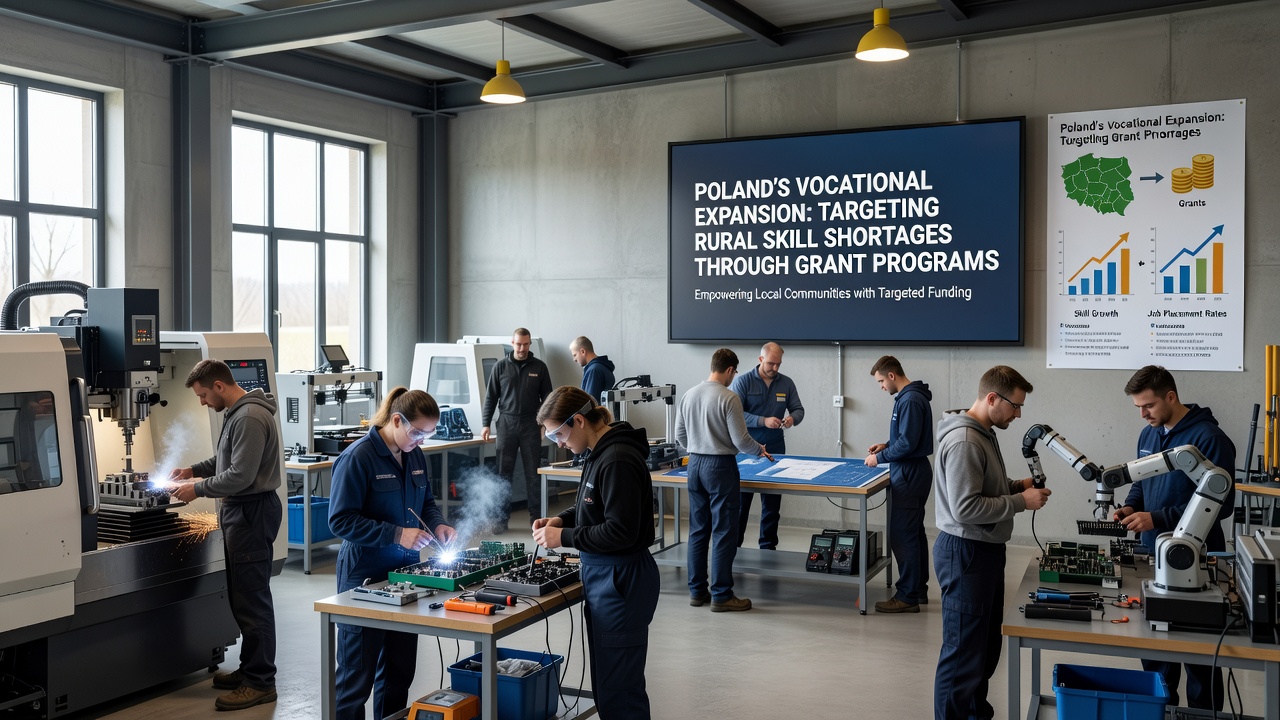
Program administrators have set a phased rollout that begins with infrastructure upgrades in the first year, followed by instructor training and curriculum development in year two. By September 2026, at least 45 new or renovated workshops are scheduled to become operational across the targeted counties. Monitoring frameworks require quarterly reporting on enrollment, certification rates, and post-training employment status. Independent evaluators contracted by the Ministry will conduct site visits and publish annual impact assessments starting in 2027.
Local governments play a central role in identifying skill shortages through regular labor market surveys. These surveys feed into regional skills compacts that align training supply with employer demand. In the Lubelskie region, for example, one such compact has already produced a 22 percent increase in apprenticeship placements during the 2024-2025 academic year, according to regional labor office records.
International Context and Comparable Approaches
Poland's approach draws on models developed in other countries facing similar rural-urban skill divides. Reports from the OECD highlight how Canada's provincial grant systems have improved retention of skilled tradespeople in remote areas by tying funding to local job placement metrics. Australia's regional skills councils, meanwhile, have used employer co-funding requirements to ensure training relevance, a feature now mirrored in several Polish grant categories. Observers note that these cross-national lessons help Polish planners avoid common pitfalls such as overinvestment in equipment without corresponding instructor development.
Early indicators suggest the Polish programs are generating interest from both public and private training providers. Over 300 applications arrived in the first round, representing a 40 percent increase compared with previous national vocational funding calls. Successful applicants must maintain gender-balanced recruitment targets and ensure at least 15 percent of participants come from groups underrepresented in vocational education, including women returning to the workforce and individuals over age 45.
Conclusion
The grant programs represent a coordinated effort to close persistent skill gaps in Poland's rural economies by directing resources toward practical, employer-aligned training. With the first major cohort of projects expected to launch by September 2026, stakeholders across education, industry, and local government will be watching enrollment figures and employment outcomes closely. Continued data collection and transparent reporting will determine whether the current design scales effectively to additional regions facing comparable labor market challenges.